
++
On December 11, 2025, the U.S. Court of Appeals issued a 54-page ruling that will likely spark more changes to the App Store policies and terms. The three-judge panel affirmed that Apple violated the court's original injunction but reversed the district court's blanket ban on all commissions. As of now, Apple’s official App Store rules and terms in the U.S. haven’t changed, and direct-to-consumer (DTC) commerce is still unrestricted with no Apple platform fees.
Here's what game developers need to understand about this latest development.
TL;DR
The appeals court upheld the contempt finding against Apple for its 27% commission and restrictive anti-steering policies.
The original injunction remains in effect. Apple cannot prohibit developers from offering external payment options.
But the ruling allows Apple to only charge "reasonable, non-prohibitive" commissions tied to actual costs.
The case has been sent back to the district court to determine what constitutes a fair commission rate.
The court also ruled that Apple has the right to restrict developers from making external links more prominent than in-app purchase options.
At the time of publishing, Apple U.S. App Store guidelines have not changed. Alternative payments are permitted with no 30% Apple tax or linking restrictions.
What changed and what remains the same
What's new:
Apple can charge commissions again – The court reversed the blanket ban. Apple can charge "reasonable, non-prohibitive" commissions tied to actual costs and limited IP compensation.
A fee determination process is coming – The case returns to the district court to decide what Apple can charge. Until a rate is approved, Apple cannot charge any commission on external payments.
Allowed costs are defined – Apple can charge for genuine costs of coordinating external links and limited IP compensation, but cannot charge for security/privacy features or App Store review processes.
Link prominence restrictions – The court ruling permits Apple to prevent external payment links from being more prominent than its own in-app purchase buttons, though external links must be allowed equal prominence.
What hasn't changed:
The core injunction stands – Apple still cannot prohibit developers from offering external payment options through buttons, links, or calls to action.
Dynamic URLs are allowed – Developers can use dynamic links that pre-authenticate users, apply coupons, and capture attribution data.
No "scare screens"– Apple cannot use warning messages designed to discourage external purchases, only neutral messages that users are leaving the App Store.
Current U.S. guidelines remain – Apple's App Store policies haven't changed yet. Alternative payments are still permitted with no Apple commission or restrictions.
Developers control their messaging – Apple must allow custom language and formatting for external payment links (subject only to general content standards, if they exist).
What the appeals court ruled
The Ninth Circuit delivered a mixed outcome that preserves developer rights to external links while opening the door for Apple to charge some commission.
Affirmed: Apple's contempt finding
The court found clear and convincing evidence that Apple willfully violated the 2021 injunction through two main violations.
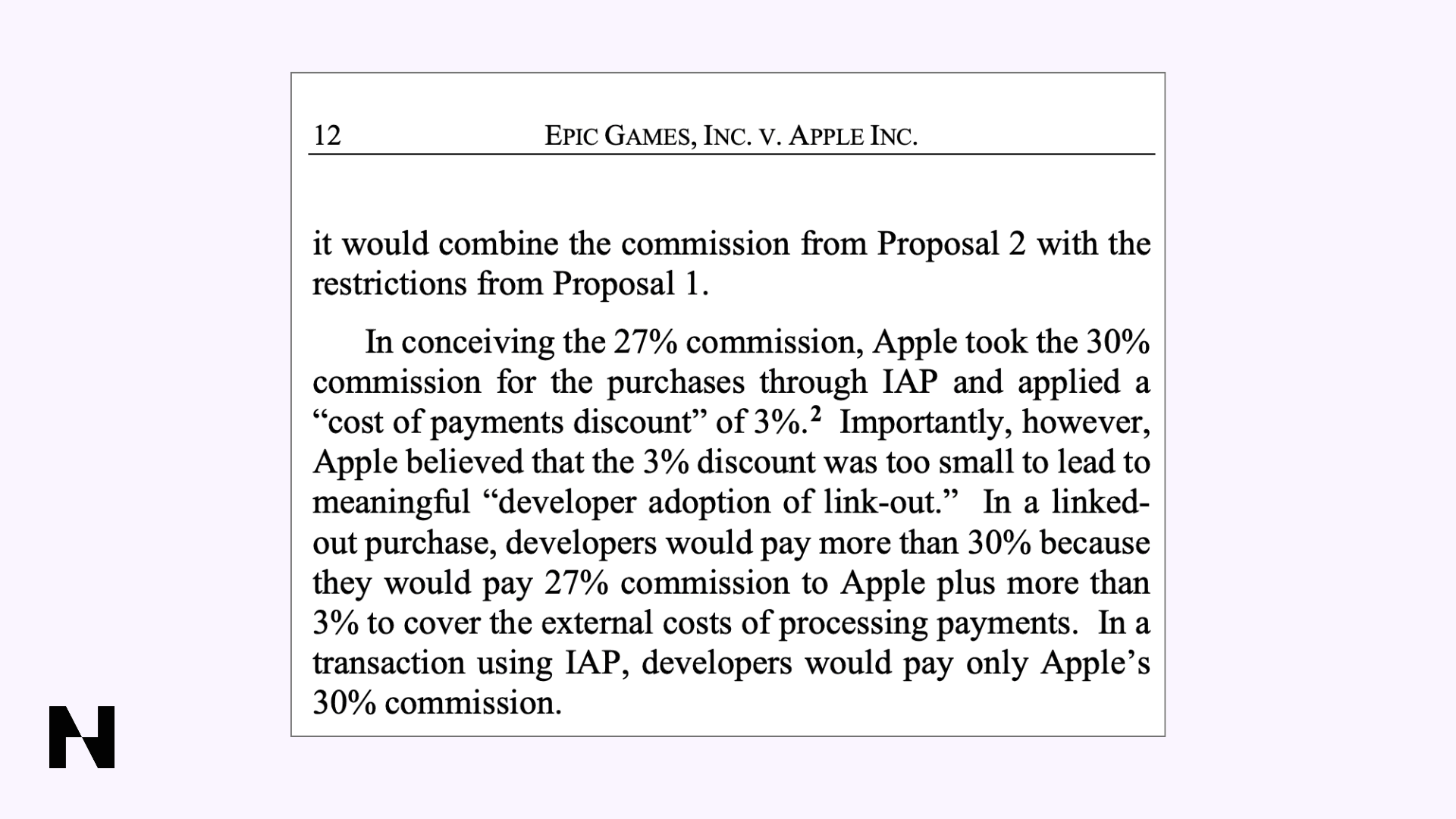
First, Apple's 27% commission on linked-out purchases had a "prohibitive effect" because developers would pay more than 30% total after covering both Apple's commission and external payment processing fees. The court documented that Apple designed this structure knowing "developers would pay more than 30% because they would pay 27% commission to Apple plus more than 3% to cover the external costs of processing payments."
Source: Epic v. Apple. No. 25-29 35, United States Court of Appeals for the Ninth Circuit, Dec. 11, 2025.
Second, Apple's link design restrictions prohibited users from completing purchases through deliberately engineered friction. The court documented how Apple required invisible "plain buttons," limited developers to five rigid templates, banned links from appearing in purchase flows, deployed warning screens engineered to "sound scary," and required static URLs that prevented automatic login.
Source: Epic v. Apple. No. 25-29 35, United States Court of Appeals for the Ninth Circuit, Dec. 11, 2025.
Reversed: The blanket commission ban
The appeals court determined that the district court overstepped by permanently banning all commissions on linked-out purchases. The court said the blanket ban went too far. Instead of letting Apple charge a reasonable fee, the district court simply banned all fees entirely. According to the ruling: "Rather than coercing Apple to comply with the spirit of the Injunction with a reasonable, non-prohibitive commission, the district court used blunt force to ban all commissions, abusing its discretion."
Source: TheVerge
Modified: Link prominence rules
The court modified how Apple can apply guidelines to how developers display external payment links. Apple can prevent developers from making external payment links more prominent than in-app purchase options. Specifically, Apple can prevent developers from using larger fonts, bigger buttons, more links, or better placement than Apple uses for its own in-app purchase buttons. However, Apple must allow developers to make their external links at least as prominent as Apple's own payment options.
What Apple can charge going forward
The appeals court provided specific guidance for determining allowable commissions on linked-out purchases:
Allowed costs:
Costs genuinely and reasonably necessary for coordinating external links.
Some compensation for Apple's intellectual property that enables external payment links (like the iOS platform and app frameworks), though the exact value remains to be determined by the district court. Since Apple already uses this same IP for in-app purchases, any costs attributed to external payments must be reduced proportionately.
Excluded costs:
Security and privacy features offered for external links.
Costs associated with App Store review processes.
The process: According to the court's opinion, Apple cannot charge any commission until the district court approves an appropriate fee, but "both parties should be encouraged to reach agreement and/or seek the court's approval of its proposed fee expeditiously." The court suggested the district court might establish a Technical Committee similar to the one used in the recent Google Play antitrust case to help determine a reasonable fee structure.
What this means for your business
For the U.S. market:
The path forward for iOS alternative payments in the U.S. currently offers a "free window" with no commissions, though the court's ruling opens the door for Apple to charge fees in the future once a rate is approved. There’s still an immediate opportunity to use external payment flows to sell directly and capture far more of your revenue. If and when an Apple alternative payments commission rate is eventually approved and put in effect, developers should analyze their DTC financials to inform their path forward.
For international markets:
Outside the U.S., nothing has changed, but there’s plenty of evolving regulations related to DTC.
Bottom line
The December 11 ruling confirms that alternative payments on iOS are here to stay, but the "zero commission" period is likely to eventually end. The appeals court upheld developers' fundamental rights to offer external payment options while preserving Apple's ability to charge for genuine platform costs. The key unknown is what the district court will determine is a "reasonable, non-prohibitive" commission rate.
For game developers, the immediate strategy remains unchanged: establish DTC pathways, build player loyalty around direct purchases, and capture first-party data while the economics are maximally favorable. If Apple implements commission fees, you'll have the infrastructure, player relationships, and data to optimize your DTC strategy accordingly.