
++
On December 18, 2025, Japan's Mobile Software Competition Act (MSCA) took effect, adding to a growing list of global regulations that are gradually loosening Apple and Google's control over mobile game distribution and payments. Following the EU's Digital Markets Act and ongoing court cases in the US, Japan has now mandated that both platforms allow alternative payment processing and app distribution options.
While the headlines suggest major changes, the reality is more nuanced. Apple and Google have implemented new options while introducing fee structures that preserve much of their revenue. Apple did reduce their standard In-App Purchase fee from 30% to 26% in Japan, but for developers using alternative payment processing, the economics don't dramatically improve. In some cases, alternative payment processing combined with third-party payment fees could cost more than the original 30% platform fee.
The one area where Apple's fees aren't prohibitively high is the 5% Core Technology Commission for apps distributed outside the App Store, though this option means forgoing App Store discovery and infrastructure.
That all being said, the regulatory trend is clear: platform control is gradually eroding, and developers are gaining more options for how they operate in Japan's significant gaming market.
What changed under the MSCA
Both Apple and Google announced compliance measures that create new options for developers operating in Japan:
Apple changes
Apple introduced several major changes with iOS 26.2 in Japan, all while warning about "new avenues for malware, fraud and scams, and privacy and security risks." Here's what's actually new:
Alternative App Distribution: Developers can now distribute iOS apps through alternative app marketplaces beyond the App Store. These marketplaces must be authorized by Apple and pass a "Notarization" review process that checks for malware and basic security threats. Apps distributed outside the App Store pay a 5% Core Technology Commission on digital goods/services sales.
Alternative Payment Processing: For apps still on the App Store, developers can now offer alternative payment options within their apps or link users to external websites to complete transactions. As part of these changes, Apple also reduced their standard In-App Purchase fee from 30% to 26% (structured as 21% commission + 5% payment processing). Here are the key details:
Apple charges 21% commission on in-app alternative payments.
Apple charges 15% Store Services Commission on external website transactions made within seven days of the link tap.
Alternative payment options must be presented alongside Apple In-App Purchase, giving users a choice.
Developers must implement in-app disclosure sheets explaining when users are transacting outside of Apple.
Apps in the Kids category cannot include links to external websites for transactions.
For users under 13, apps cannot link to external websites for transactions.
For users under 18, apps must include a parental gate before alternative payment processing or external links.
Apple charges fees on transactions made within seven days of following an external link.
Browser and Search Flexibility: Users in Japan will see choice screens for default browsers and search engines, and developers can now use alternative browser engines beyond WebKit.
Google changes
Google's approach reflects Android's more open architecture, with expanded billing options for all app categories:
Alternative App Distribution: Unlike Apple's App Store changes, nothing changed here for Android. Third-party app marketplaces have always been permitted on Android, and several are already operational in Japan and globally, including Samsung Galaxy Store, Amazon Appstore, Huawei AppGallery, and others.
Expanded User Choice Billing: Google extended its User Choice Billing program to cover all games offering in-app purchases of digital content in Japan. Previously, only non-gaming apps were eligible. Key details:
Developers must offer both their alternative billing system and Google Play Billing side-by-side
Service fees are reduced by 4% when users choose the alternative billing option (26%)
Developers must use alternative billing APIs to automate transaction reporting
Available for both gaming and non-gaming mobile or tablet apps
External Payments Program (New): Google introduced a separate program that enables developers to link users from their app to external payment pages on the developer's website or in a payment app. Key details:
External payment links must be presented side-by-side with Google Play Billing within the app.
Links can only direct to a payment page for specific digital items the user has already selected in-app.
Google charges 20% on purchases of digital goods and services made within 24 hours of following an external payment link.
Developers must use external payments APIs to report transactions and surface required user experiences.
Apps enrolled in the External Payments Program cannot also use User Choice Billing.
Developers must be registered as a business, and apps cannot target users under 13.
Browser and Search Choice Screens: Similar to Apple, Android users in Japan will see choice screens prompting them to select their preferred search engine and browser.
Understanding the Fee Structures
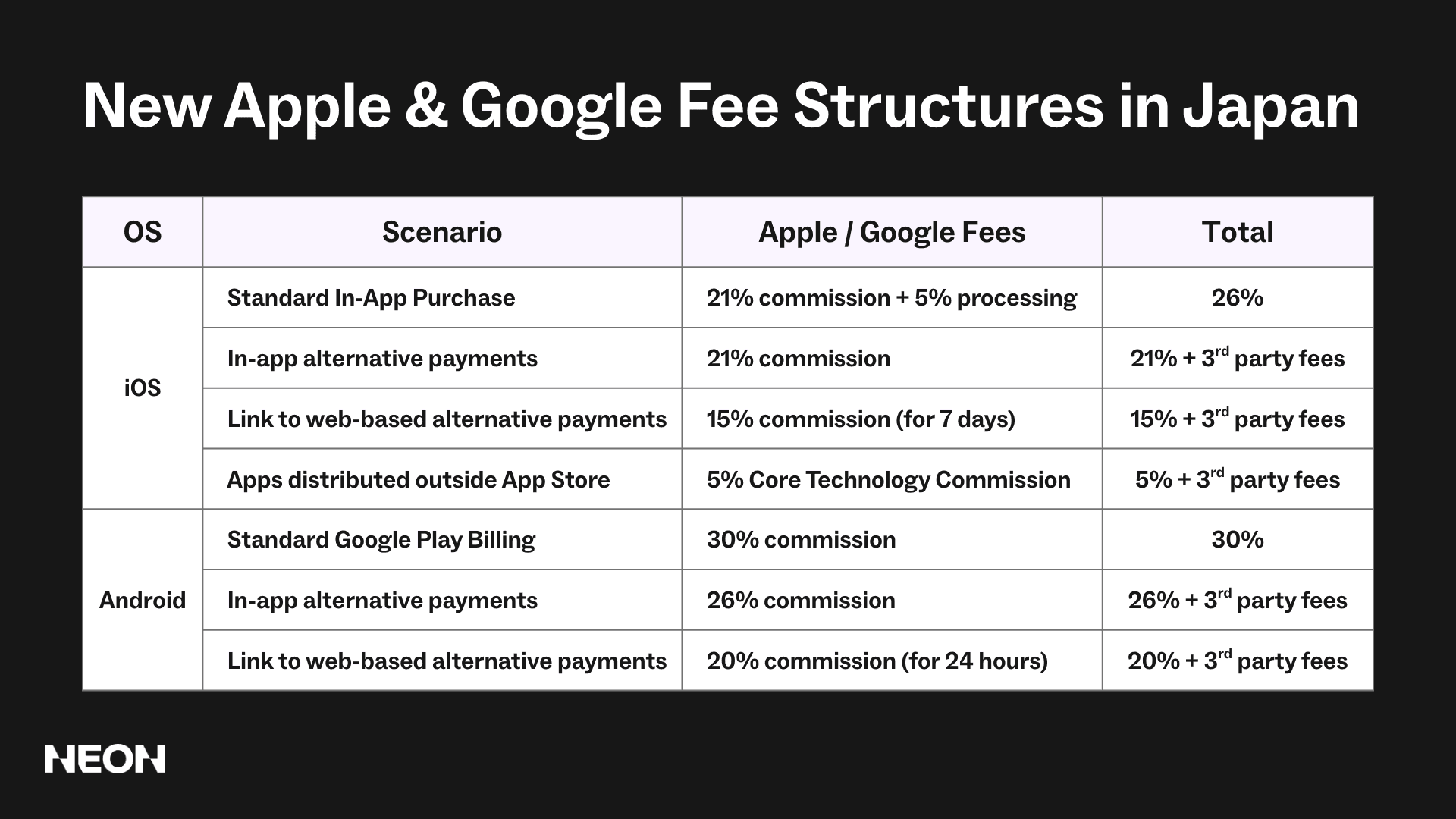
While both platforms opened up payment options, here's what you'll actually pay:
What This Means for Developers
The new payment options in Japan come with complex economics. For many developers, the combination of platform fees and third-party payment processing costs means the math doesn't favor switching from standard App Store or Google Play billing. However, some may find value in owning complete transaction data and player relationships, even at equivalent costs.
One area that presents genuine financial upside is Apple's 5% Core Technology Commission for apps distributed through alternative app marketplaces, which represents a significant saving opportunity compared to the App Store's 15–26% fees. The challenge is distribution: alternative marketplaces currently lack the reach and discovery mechanisms of the established stores. However, if a credible third-party marketplace emerges in Japan that can deliver meaningful user acquisition and rival the App Store's distribution capabilities, this fee structure could prove highly valuable for game developers.
Each developer will need to evaluate their specific situation: the size of their player base in Japan, their ability to drive conversions through external payment flows, and whether the strategic benefits of data ownership and operational flexibility justify the economics. Japan joins the EU, South Korea, and the US in creating options for direct-to-consumer commerce in mobile games, and the path forward depends on your studio's unique circumstances.
Fee table for accessibility:
New Apple & Google Fee Structures in Japan
OS | Scenario | Apple / Google Fees | Total |
iOS | Standard In-App Purchase | 21% commission + 5% processing | 26% |
In-app alternative payments | 21% commission | 21% + 3rd party fees | |
Link to web-based alternative payments | 15% commission (for 7 days) | 15% + 3rd party fees | |
Apps distributed outside App Store | 5% Core Technology Commission | 5% + 3rd party fees | |
Android | Standard Google Play Billing | 30% commission | 30% |
In-app alternative payments | 26% commission | 26% + 3rd party fees | |
Link to web-based alternative payments | 20% commission (for 24 hours) | 20% + 3rd party fees |