++
TL;DR
- On March 4, 2026, Google announced new Play Store fees, reached a commercial agreement with Epic Games, and withdrew its Supreme Court appeal. Here's what each document says and what it means for DTC.
- Webshop linking and alternative in-app billing remain available in the US. The existing court order requires Google to allow both, and nothing in the March 4 announcements changes that.
- No new US fees have gone into effect. The March 4 announcements do not impose any new fees on alternative billing or external links in the US.
- Future US fees are unresolved. The Google-Epic agreement sets no US fee rates for these paths. Proposals from December 2025 (25% for alternative billing, 20% for external links) may or may not still apply. The April 9 court hearing is the next opportunity for clarity. UPDATE: On March 11, Judge Donato requested "Friend of the Court" briefs in early April, which may delay any decision.
- Outside the US, alternative in-app payments and webshop linkouts will be subject to a 20% Google fee (or 15% if the developer is enrolled in the Apps Experience Program or Google Play Games Level Up).
What just happened?
On March 4, 2026, Google published a blog post announcing major changes to Play Store fees. Most coverage stopped there. But March 4 actually produced three distinct documents, each with different scope, different authority, and different implications for developers running DTC revenue. Reading only the blog post leaves you with an incomplete and in some ways misleading picture.
Here's what each document says, what it doesn't, and what it means for your business.
Source 1: Google's blog post
Google's "A new era for choice and openness," written by Sameer Samat (President of Android Ecosystem), introduced a new fee model that separates a "service fee" from a "billing fee." Here's what it announced for developers using Google Play Billing:
Billing fee: 5% for using Google's own billing system, on top of the service fee below.
Service fees, enrolled developers (in the soon-to-be-launched Apps Experience Program or Google Play Games Level Up):
- 15% on transactions from new installs (first installs after fees launch in a region)
- 20% on transactions from existing installs
Service fees, non-enrolled developers:
- 20% on transactions from new installs
- Rate for existing installs: not stated
Google's blog explicitly defines an existing-installs rate only for enrolled developers. For everyone else, the blog is silent on what they pay on purchases made by users who already have the game installed when the new fees go live. Google noted it "plans to share additional details in the coming months." This may be one of them.
In practice, total fees using Google Play Billing:
- Enrolled, new installs: 20% total (15% service + 5% billing)
- Enrolled, existing installs: 25% total (20% service + 5% billing)
- Non-enrolled, new installs: 25% total (20% service + 5% billing)
- Non-enrolled, existing installs: TBD
- Subscriptions (all developers): 15% total (10% service + 5% billing)
Rollout timeline:
- EEA, UK, and US: by June 30, 2026
- Australia: by September 30, 2026
- Korea and Japan: by December 31, 2026
- Rest of world: by September 30, 2027
What the blog doesn't say. The blog states that developers "will have the option to use their own billing systems in their app alongside Google Play's billing, or they can guide users outside of their app to their own websites for purchases." It preserves alternative billing and external links in principle. But it publishes no fee rates for either path. If you're running a webshop or using alternative in-app billing, the blog tells you nothing about what you'll pay.
Source 2: The binding term sheet
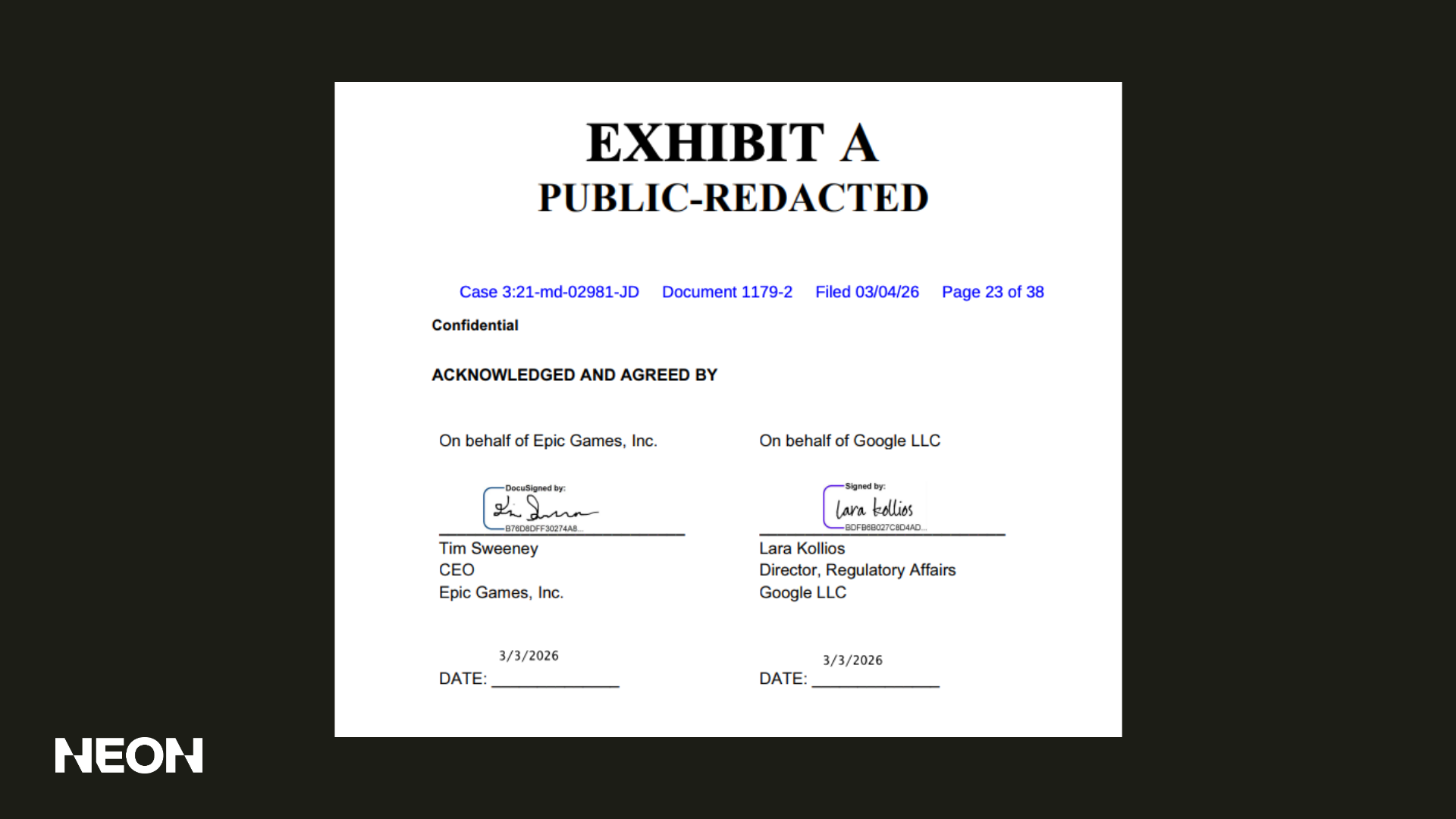
Filed alongside the blog post was a signed commercial agreement between Google and Epic. This is the document that actually answers the DTC and alternative billing questions the blog skips over.
A note on terminology: throughout this agreement, the rates for alternative billing and linkouts are written as maximums, "Google may charge a service fee not to exceed X%." That's why we're calling them fee caps rather than fees. They set a ceiling on what Google can charge, not a fixed rate. Outside the US, where these caps exist, they're a contractual limit. Inside the US, where no cap has been set, we simply call them fees, because right now there's no ceiling.
The US is carved out, and if you're running DTC today, nothing here changes that. The term sheet does not set specific fee rates for alternative billing or external link transactions in the US. The fee caps, payment choice protections, and anti-steering rules in this agreement apply only outside the United States. Inside the US, the governing document is a separate court order, which requires Google to allow alternative billing and prohibits it from penalizing developers who direct users to outside purchase options, but does not cap what Google can charge on those transactions. If you are currently running a webshop or using alternative in-app billing in the US, nothing in this agreement affects your situation. The next signal on US fees is the April 9 court hearing. UPDATE: On March 11, Judge Donato requested "Friend of the Court" briefs in early April, which may delay any decision.
Outside the US: fee caps apply to all payment methods. The agreement states that the fee caps "will apply regardless of the method of billing (e.g. Google Play Billing, alternative billing service, or linkout)." For new installs outside the US, the 20% (non-enrolled) or 15% (enrolled) service fee cap applies whether the transaction goes through Google Play Billing, alternative in-app billing, or a link to a webshop. The additional 5% billing fee only applies if you use Google Play Billing specifically.
Existing installs via external links are capped at 20% outside the US. That answers the question the blog left open, at least for the external link path. Alternative in-app billing on existing installs remains a gap in the agreement.
The 24-hour attribution window survives. Google can charge service fees on transactions made on a linked website within 24 hours of a user clicking an external link, regardless of where the purchase is completed.
These non-US fee caps take effect regardless of what the court does. The agreement explicitly states it takes effect "regardless of whether the Court approves or rejects the Revised Modified Injunction." The April 9 court hearing cannot block the non-US fee caps from going into effect.
The agreement runs approximately five years from the completion of global rollout (global rollout completes September 30, 2027, putting the expiration around 2032).
Source 3: The court update
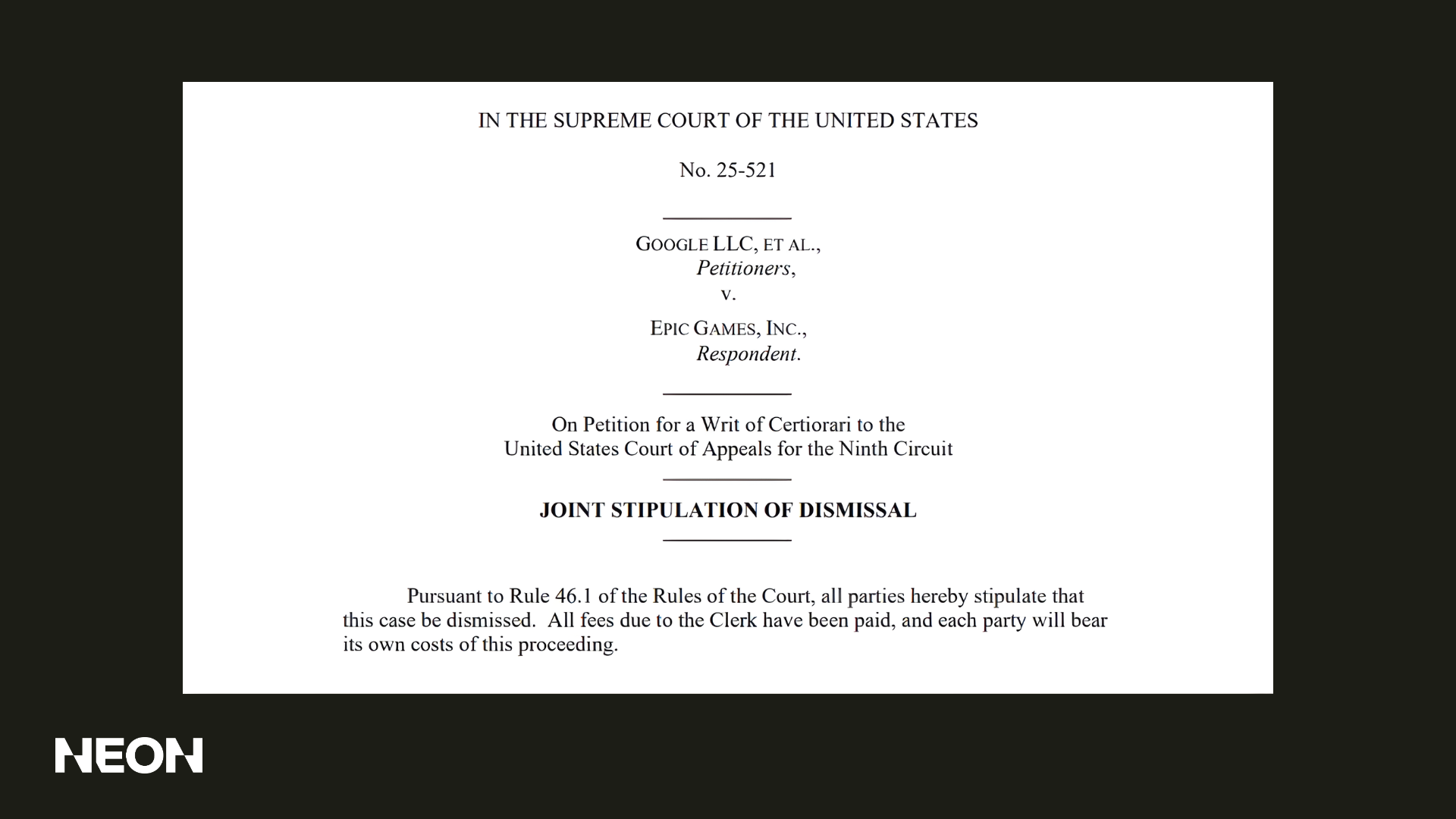
The third document filed on March 4 was a joint motion from Google and Epic asking the court to update the existing injunction to reflect their new agreement. It also confirmed that Google is withdrawing its appeal to the US Supreme Court.
Some background on why this matters: after losing at trial, Google appealed the case, and that appeal had been working its way up through the courts. With both sides now in agreement on the terms, the appeal is being dropped. The earlier court rulings that found Google liable for antitrust violations are now final, with no further appeal possible.
What remains before the court at the April 9 hearing is narrower: the judge will decide whether to formally enter the updated court order that reflects the new agreement. That ruling determines whether the US Registered App Stores program moves forward, and it may also address what fees, if any, Google can charge in the US on alternative billing and external link transactions.
What this means for your DTC and webshop revenue
The question most developers are actually asking: My in-app purchases are going from 30% to 25%. Fine. But a big chunk of my revenue runs through DTC where my effective rate is closer to 6%. Is that going away?
DTC through in-app alternative billing and/or webshop linkouts at scale on Android has been almost entirely a US story. Outside the US, alternative billing and webshop linking are technically allowed, but Google's fee structures for those paths made them economically unviable. The new fee caps in the commercial agreement change the rules outside the US, but they're largely changing rules that developers weren't benefiting from anyway.
The market that matters is the US, and on that front nothing has changed yet.
- Can you still do webshop linking or alternative in-app billing in the US? Yes. The existing court order requires Google to allow both. Nothing in the March 4 announcements changes that. Google cannot remove or block those options.
- Have any new fees for webshop linking or alternative billing gone into effect in the US? No. No new fees are in effect. The March 4 announcements do not impose new US fees on alternative billing or external links.
- What fees might be implemented, and when? This is genuinely unresolved. The signed agreement between Google and Epic does not set fee rates for US webshop linking or alternative billing. The previous proposals from December 2025 suggested 25% for alternative in-app billing and 20% for external content links in the US, but it's unclear whether those are still operative, superseded, or subject to further court direction. The April 9 hearing is the next opportunity for clarity. In a parallel Apple case, the judge overseeing that matter has treated the fee level on external link transactions as an antitrust question rather than a pure business decision, and the April 9 hearing may offer the first indication of whether Judge Donato agrees.
What to watch
April 9 is the next inflection point, but with a narrower scope than most coverage implies. The court will rule on the updated injunction, which determines the US Registered App Stores program and may set parameters on US alternative billing and external link fees. The fee structure outside the US, and the end of the Supreme Court appeal, are already settled.
UPDATE: On March 11, Judge Donato requested "Friend of the Court" briefs in early April, which may delay any decision.
We'll publish an update after the April 9 hearing. In the meantime, if you have questions about what this means for your webshop or alternative payments strategy, talk to our team.