++
TL;DR
- Google now offers two programs for developers offering alternative payments to U.S. users: External Content Links and Alternative Billing.
- The key difference is UI control. Content Links lets you design the payment selection screen (including bonus messaging), while Alternative Billing uses a standardized Google template.
- Both programs require integration with the Google Play Billing Library, but at different version levels.
- Unity IAP does not currently support either program out of the box, though Unity's release notes indicate work is underway for Content Links support.
Program Summary
| Program | UI Control | Bonus Messaging at Selection | API Requirement | Unity IAP Support |
|---|---|---|---|---|
| External Content Links | Developer | Yes | Play Billing Library 8.2.1+ | Not yet (in progress) |
| Alternative Billing | Google template | No (but allowed elsewhere in-app) | Play Billing Library 5.2+ / 6.2.1+ | No |
What Google announced
On December 9, 2025, Google announced new policies and requirements for developers offering alternative billing or in-app payment links for U.S. users. For the full breakdown, see our previous post.
The fees outlined in Google's announcements are potential fees that are not currently in effect, with no known timeline for collection. The fee structure is heavily contingent on rulings in the ongoing Epic v. Google settlement, which remains held up in court with the next hearing scheduled for March 2026.
The two programs
Google requires developers who want to offer alternative payments or link to external checkouts to enroll in one of two programs. Google doesn’t explicitly prescribe specific qualifications for one versus the other. Developers can choose which to implement based on their interpretations of the guidelines, preferred user experience and technical capabilities.
External Content Links Program
For developers who link users from their app to an external destination to complete purchases. The "external" refers to completing the purchase outside of Google Play Billing, not necessarily outside of the app's UI. The checkout destination can be displayed in a browser, in a webview, or another app store already installed on the user's device.
Alternative Billing Program
For developers who process payments via a non-Google billing system within the app itself. Note: this program does not restrict developers from completing the purchase through an external checkout once the alternative billing option is chosen.
Key difference: UI control
The primary difference between the two programs is who controls the payment selection experience.
External Content Links
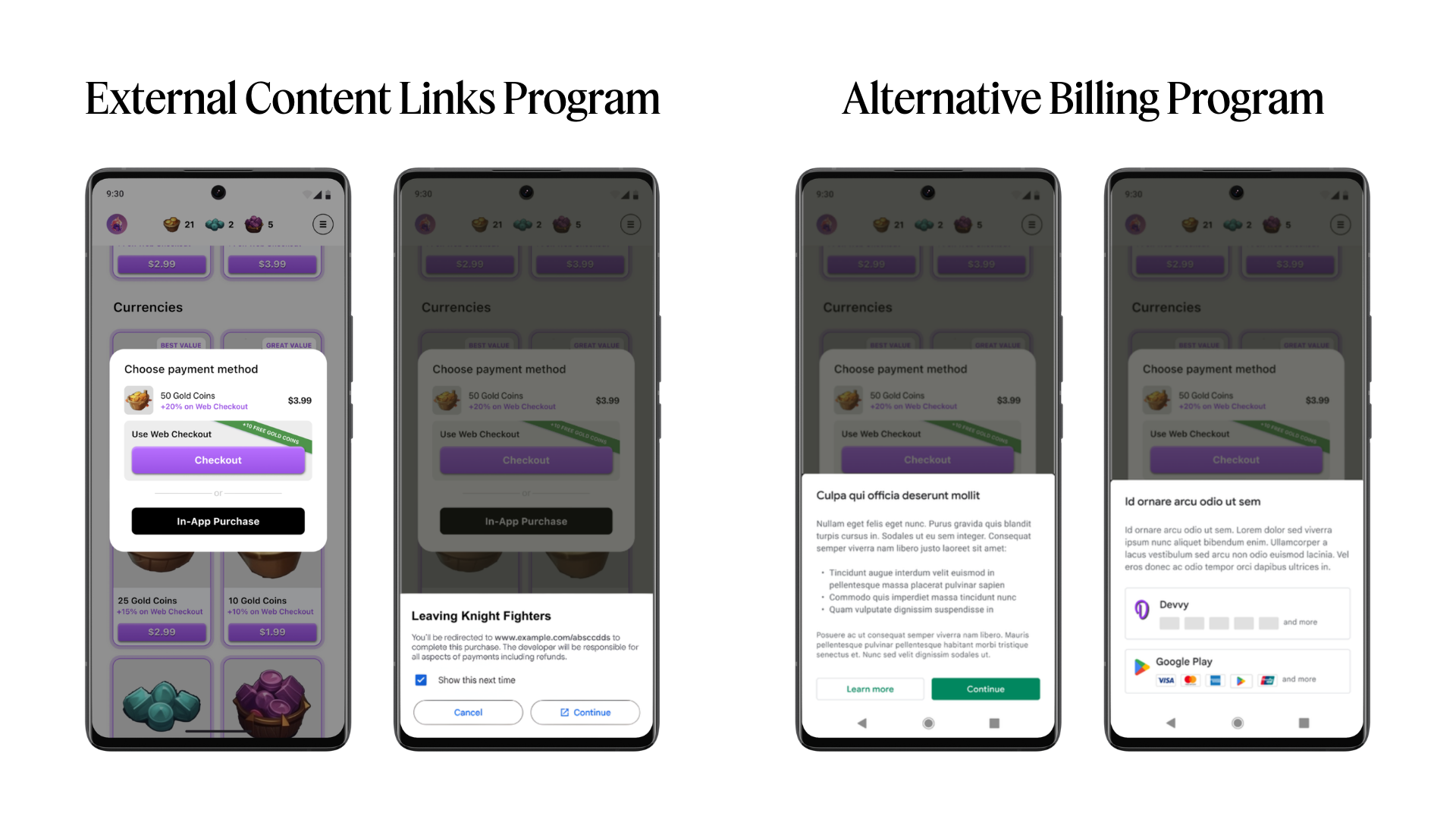
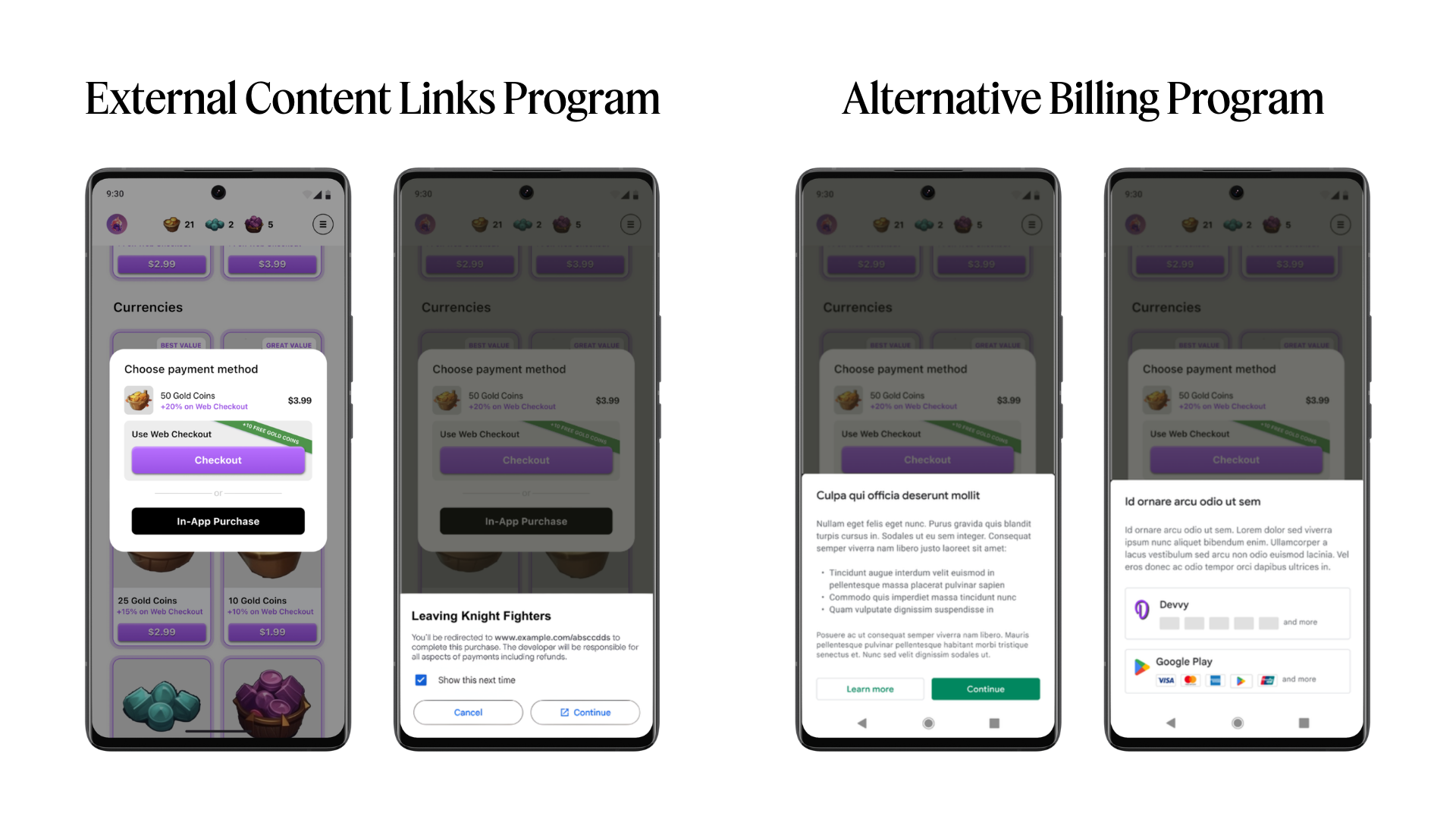
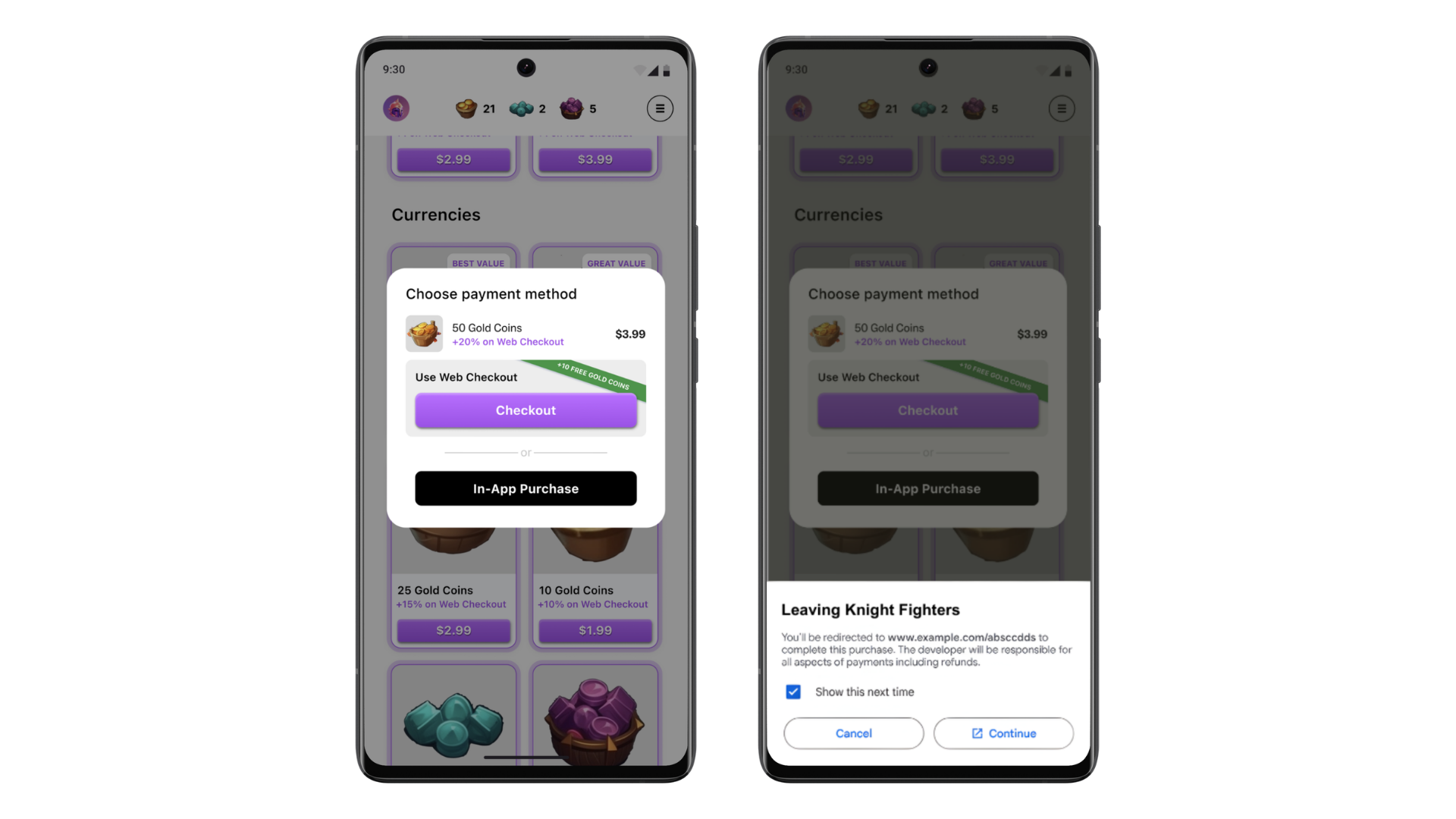
The developer controls the in-app UI that triggers the external link. This means you can design the payment selection screen, including any bonus or incentive messaging (e.g., "Get 10% bonus gems!"). Google displays a brief information screen when the user taps the link. This screen can be dismissed permanently by the player if they uncheck "Show this next time."
Alternative Billing
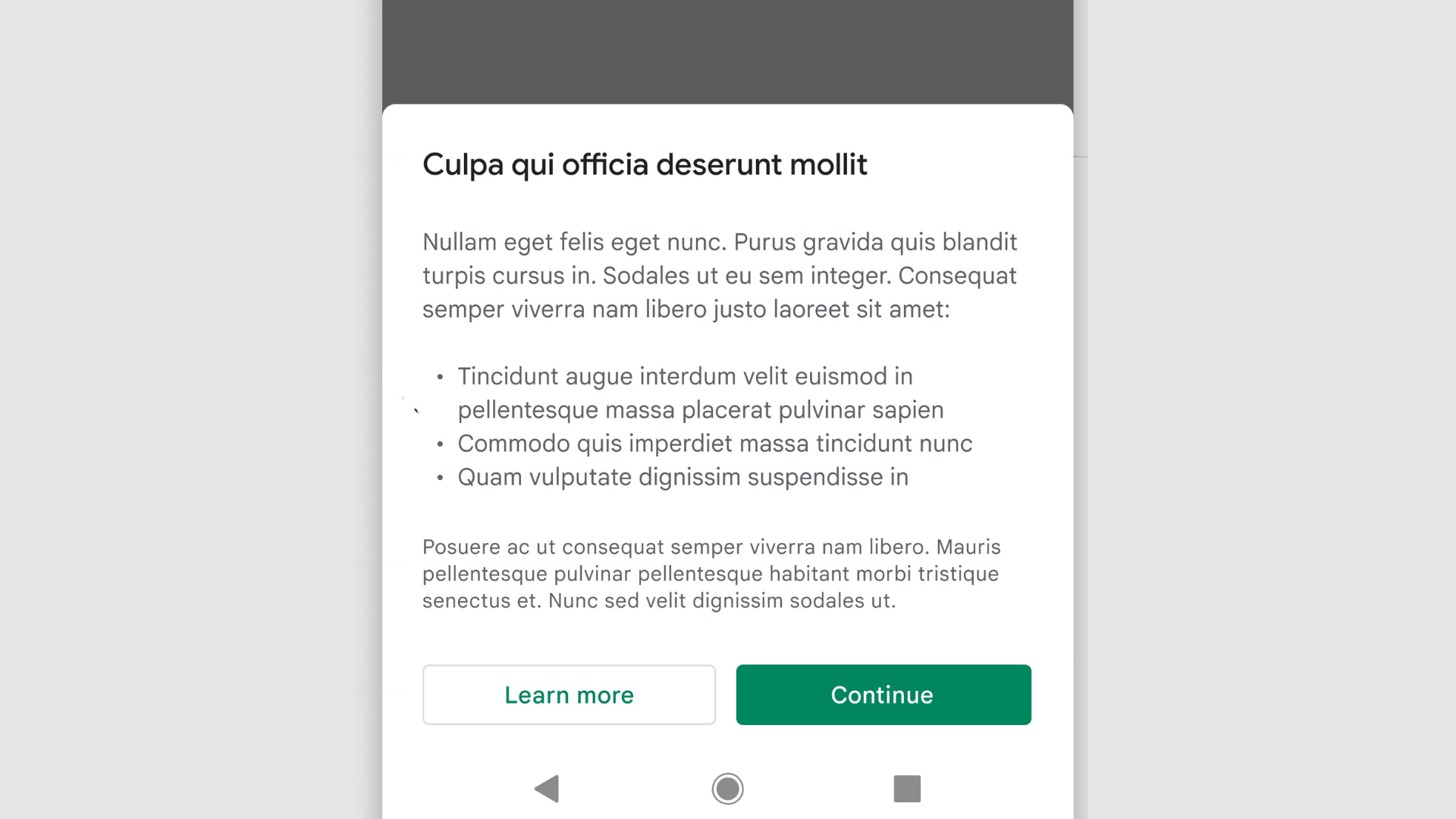
On a user's first purchase after you implement alternative billing, Google displays a one-time information screen explaining the changes to their checkout options. This screen describes what the user's choice will determine: who secures and processes their payment, who provides customer support, and which benefits are available.
After the user continues past this screen, subsequent purchases go directly to the billing choice screen.
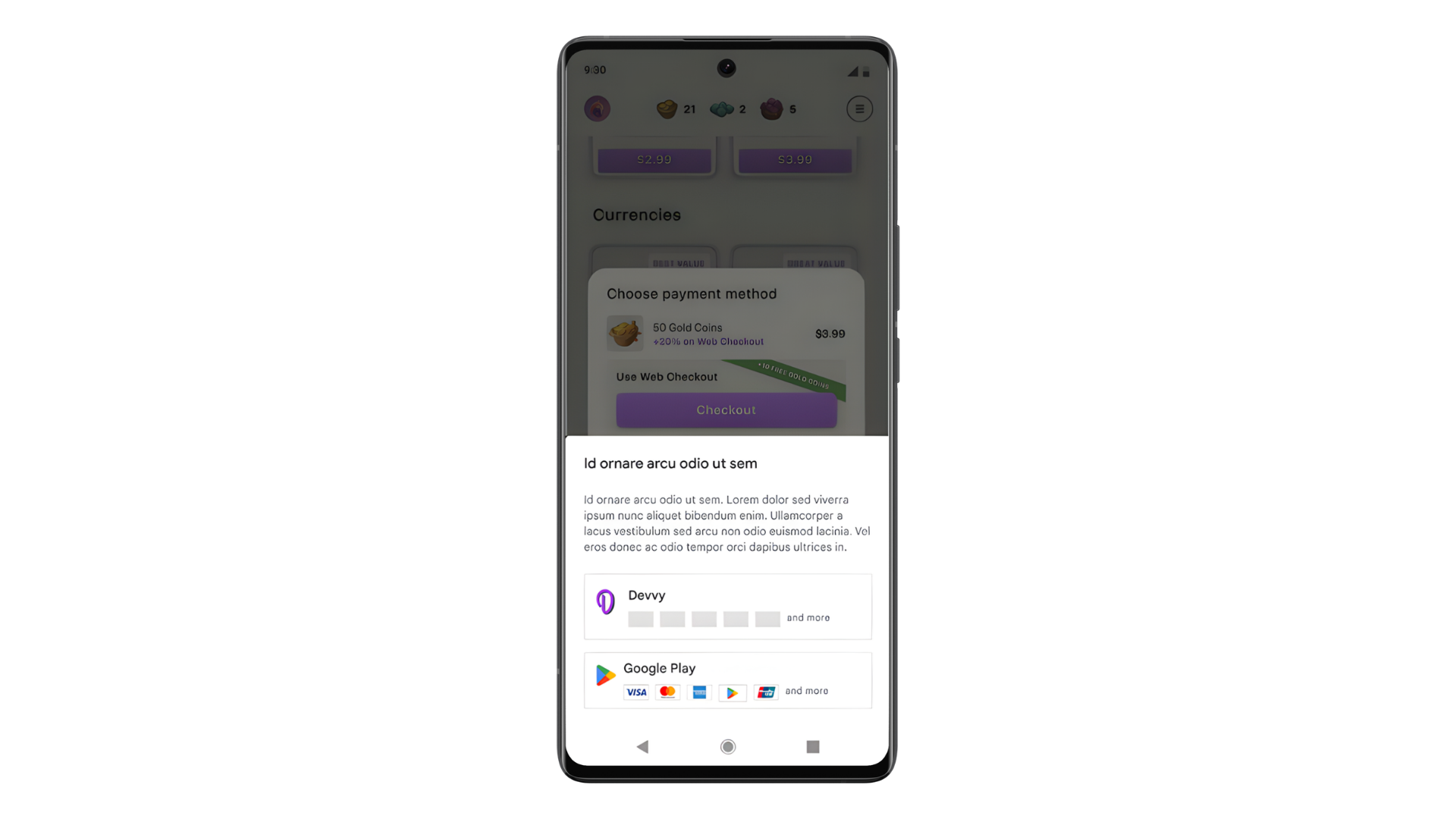
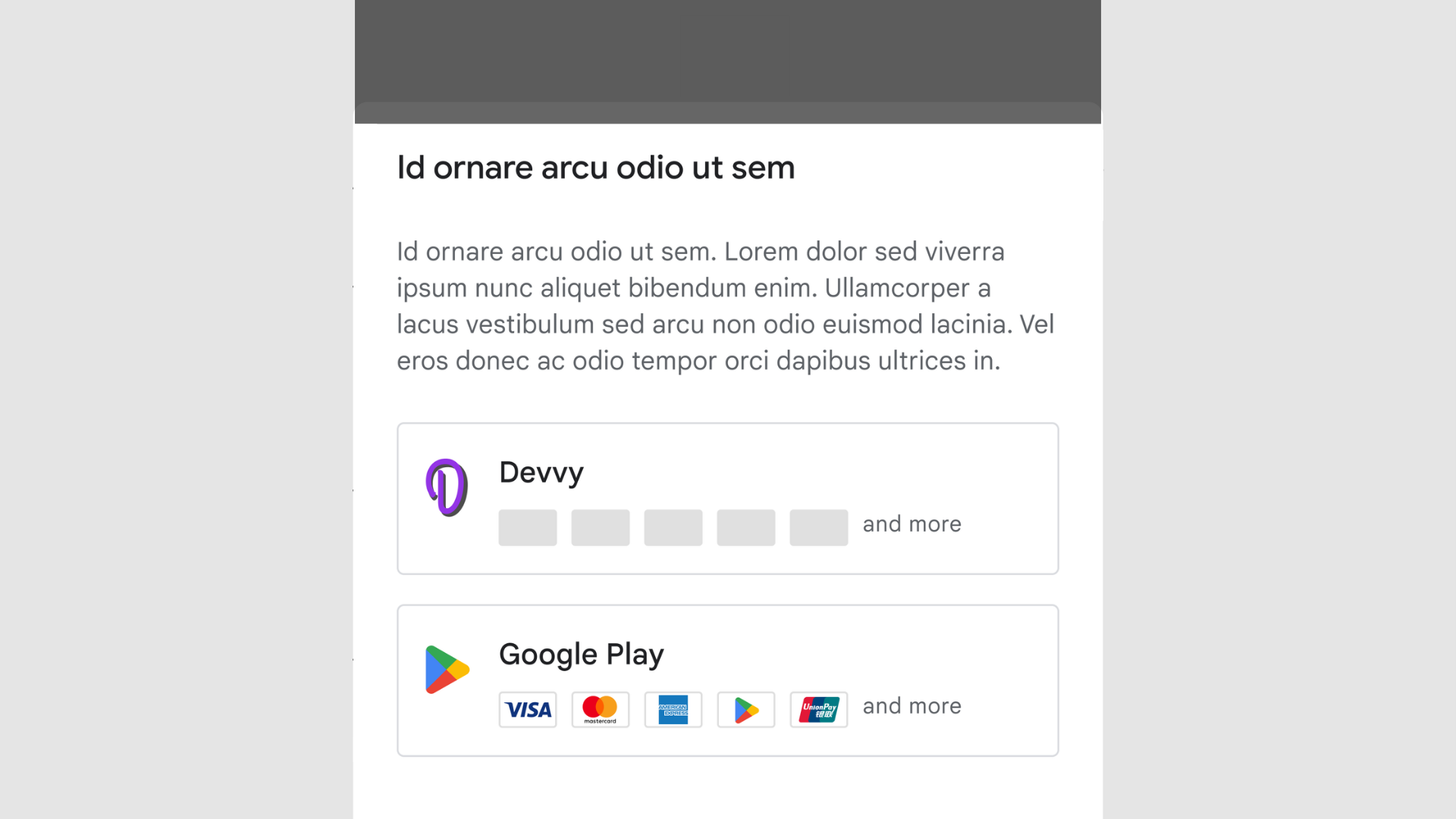
Google controls the billing choice screen using a standardized template. The developer can customize:
- An icon image
- A brand name
- Images showing supported payment method logos (max 5)
- Optional "and more" text
The straightforward approach: use your game or publisher brand name and logo on the billing choice screen so players recognize it.
The developer cannot add promotional text, bonus callouts, or pricing comparisons to this screen. Per Google's UX guidelines, the screen must present both options in a "fair and equal manner."
Communicating value before the payment screen: The Epic v. Google injunction removed anti-steering restrictions. Google explicitly states they will not prohibit developers from communicating about alternative payment methods. This means you can communicate value propositions elsewhere in your app before the player reaches Google's payment selection screen.
Since the User Choice screen itself cannot show incentive messaging, consider communicating the benefits of your alternative checkout option in other places:
| Where | Example |
|---|---|
| Store banners | "Get 10% bonus gems when you choose web checkout!" |
| Product listings | Show bonus amounts alongside base amounts |
| Shop pop-up | "You'll see two options, choose [Your Brand] for extra value" |
| In-game messaging | Educate players about the benefit before they shop |
By the time Google's neutral User Choice screen appears, players already know why they should pick your option.
Implementation options
If you choose External Content Links
Requirement: Play Billing Library 8.2.1+
Option 1: Wait for Unity IAP support
If you use Unity IAP, you can wait until the latest Google Play Billing Library is supported and integrated.
- Unity IAP 5.0.0 shipped in August 2025 with Billing Library 8.0.0, which does not meet the 8.2.1+ requirement.
- Unity's IAP 5.2.0-pre release notes indicate work is underway for External Content Links support, but no official timeline has been provided.
Option 2: Build a custom native plugin
Build a custom native Android plugin that integrates directly with Play Billing Library 8.2.1+.
- If your project does not use Unity IAP, this can be the simplest approach. You directly extend your existing bridge between the game and the Google Play Billing Library.
- If Unity IAP is already in use and must be retained, this requires additional care:
- Build a custom native Android component that coexists alongside Unity IAP
- Manage dependency unification to ensure the project uses the newer Billing Library version
- Increases implementation complexity and maintenance overhead
If you choose Alternative Billing
Requirement: Play Billing Library 5.2+ (user choice) or 6.2.1+ (alt billing only)
Option 1: Build a custom native plugin
Build a custom native Android plugin that integrates directly with the Google Play Billing Library at the required version.
- Gives full control and maximum flexibility
- Higher development and maintenance overhead
- If your project does not use Unity IAP, this is the most direct approach
Option 2: Unity IAP (limited support)
We do not currently see any updates from Unity IAP regarding support for the Alternative Billing program's required APIs.
- Unity IAP internally depends on the Google Play Billing Library, but does not expose the API functions required for Alternative Billing
- Missing functionality includes: user choice handling, external transaction reporting
- In theory, you could build a native Android plugin that accesses the Google Play Billing Library bundled with Unity IAP
- However, this introduces significant architectural complexity and may not be viable for most projects
Summary
| Program | UI Control | Bonus Messaging at Selection | API Requirement | Unity IAP Support |
|---|---|---|---|---|
| External Content Links | Developer | Yes | Play Billing Library 8.2.1+ | Not yet (in progress) |
| Alternative Billing | Google template | No (but allowed elsewhere in-app) | Play Billing Library 5.2+ / 6.2.1+ | No |
Current status of Epic v. Google
The January 22, 2026 hearing on the Epic v. Google settlement did not produce any official decisions or changes:
- The focus was on third-party app stores and their potential access to the Android global app catalog.
- The fee structures from both the proposed settlement (9%/20%/+5%) and Google's December 9th policy announcement (25% alternative billing / 20% external linking) were not mentioned.
- Judge Donato expressed skepticism, stating: "You've got a hike to tell me that something has changed so much in the world that I should change that injunction, and I'm not hearing it."
Both sides have until early March 2026 to file additional briefs. No decision on the settlement yet.
Bottom line: If you're waiting for clarity on Google's fee structure for alternative in-app billing and linking to web-based payments, you'll be waiting until at least March. In the meantime, the current window (since October 29, 2025) remains unique: alternative payments in the U.S. with no platform fees being collected.